
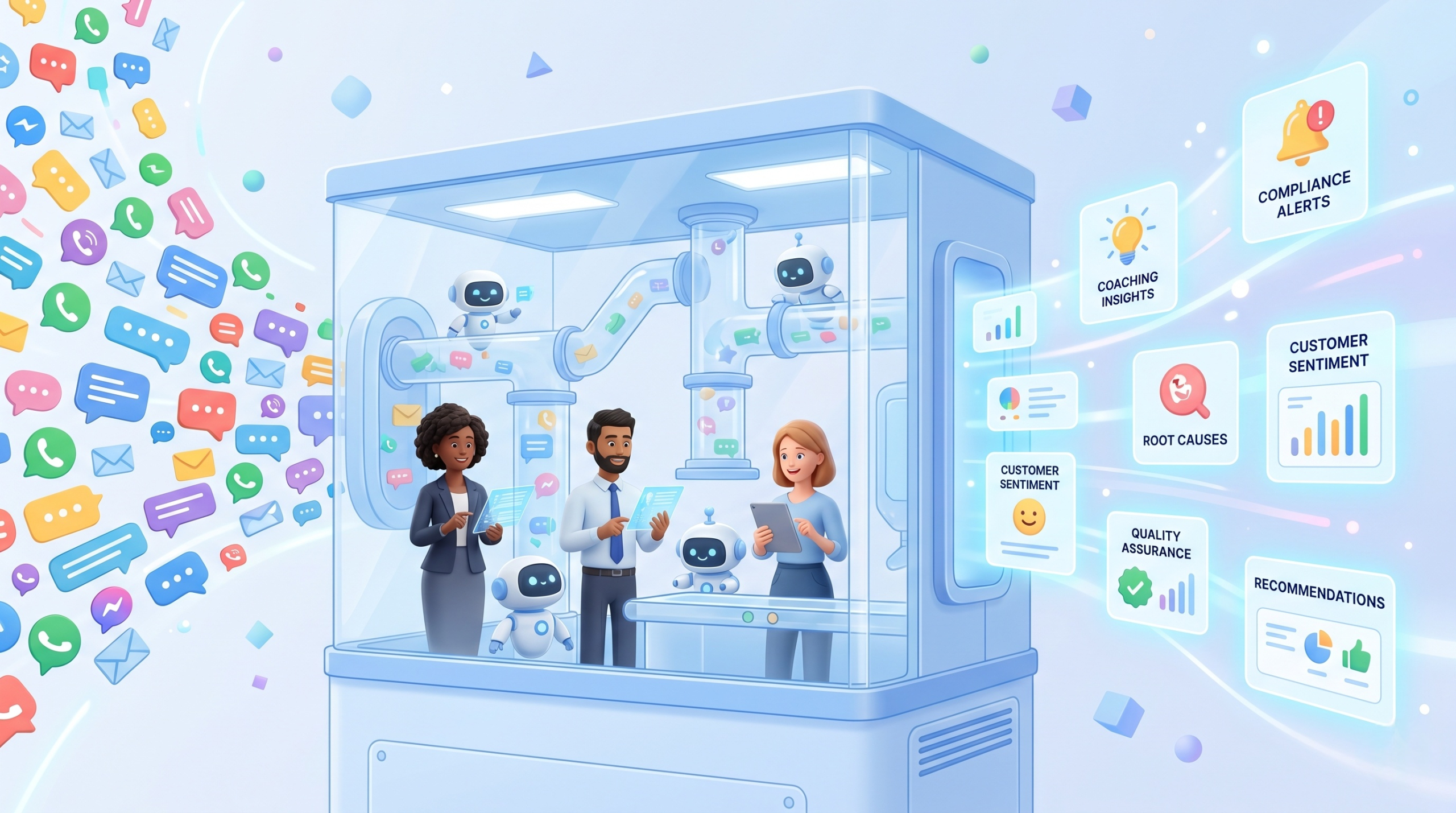
Every customer conversation contains valuable business intelligence.
A sales call reveals objections that slow down deals. A support interaction highlights recurring product issues. A compliance conversation can help find risks early, before they turn into bigger problems that cost time or money.
Yet in most enterprises, these insights remain hidden.
The surprising part isn’t that organizations lack conversation data. Most already have more customer data than they can effectively analyze. The challenge is turning thousands of interactions across calls, chats, emails, and messaging channels into actionable insights.
This is where a modern Conversation Intelligence Platform comes in.
However, many platforms promise intelligence while delivering little more than dashboards and reports.
And that’s exactly where the problem begins.
What Is a Conversation Intelligence Platform?
A Conversation Intelligence Platform uses AI to analyze customer interactions across communication channels and turn them into actionable business insights.
Unlike traditional analytics tools that focus on reporting metrics, conversation intelligence helps organizations understand why issues occur, identify emerging trends, monitor compliance, improve agent performance, and recommend actions that drive results.
In simple terms, it helps enterprises move from observing conversations to learning from them and acting on them.
The Growing Cost of Missed Conversation Insights
Every day, enterprises make decisions based on reports, surveys, and operational metrics. Yet some of the most valuable business intelligence comes directly from customer conversations.
The real challenge is when large organizations have to handle hundreds of thousands or even millions of customer interactions every year. As conversation volumes grow, manual review becomes increasingly difficult.
According to Salesforce’s State of the Connected Customer research, 56% of customers say they often have to repeat or re-explain information to different representatives. This highlights how customer knowledge often remains scattered across teams, channels, and systems, making it harder for organizations to deliver consistent experiences and act on customer insights.
In most QA teams, only a tiny fraction of customer conversations often get reviewed manually which clearly means that the decisions are often made out of incomplete visibility.
Why Dashboards Alone Are No Longer Enough
Dashboards rarely tell you what happened.
They might show that customer complaints increased or satisfaction scores dropped.
But they rarely explain that why it happened, who affected, what caused the issue or what possible actions should be taken.
The biggest mistake enterprises make is assuming that more reporting automatically leads to better decisions. In reality, many teams spend more time interpreting reports than acting on the insights hidden within them.
Imagine discovering that customer complaints increased by 20%.
Dashboards don’t drive action. People do.
A true conversation intelligence platform can identify the root cause, affected customer segments, and the actions required to resolve the issue.
That’s the difference between reporting and intelligence.
Conversation Intelligence Platform vs Traditional Analytics Tools
Traditional analytics focuses on what has already happened through reports and dashboards. Conversation intelligence goes further by explaining why it happened and what it means for business decisions. This helps organizations shift from reactive analysis to proactive, insight-driven action.
1) Explains Why, Not Just What
Traditional analytics helps organizations understand what happened by presenting reports, dashboards, and performance metrics. A Conversation Intelligence Platform goes a step further by uncovering why something happened, helping teams identify root causes, customer concerns, emerging trends, and areas for improvement.
2) Goes Beyond Sampled Reviews
Most organizations review only a small fraction of customer interactions through manual QA processes. Conversation Intelligence platforms analyze conversations at scale, providing broader visibility into customer interactions and reducing the likelihood of missing critical insights.
3) Automates Quality Assurance
Manual quality assurance is often time-consuming and limited by available resources. Conversation Intelligence platforms automate the evaluation process, helping teams monitor conversation quality more efficiently, consistently, and at scale.
4) Turns Data into Actionable Intelligence
Traditional dashboards often present information without clear next steps. Conversation Intelligence platforms transform conversation data into actionable insights, enabling teams to make faster, more informed decisions and address issues before they impact customers.
5) Enables Proactive Decision-Making
Traditional analytics is largely reactive, helping organizations understand past performance. Conversation Intelligence helps identify risks, opportunities, and customer concerns earlier, allowing teams to take proactive action rather than simply reacting to problems after they occur.
For enterprises, the difference is simple: traditional analytics focuses on reporting, while conversation intelligence focuses on understanding, action, and continuous improvement.
What Enterprises Should Demand Before Buying
Before investing in a platform, enterprise buyers should focus on capabilities that drive measurable outcomes.
Look for solutions that provide:
- 100% conversation coverage
- Automated quality assurance
- Real-time agent assist
- AI-powered coaching
- Knowledge AI and natural-language search
- CRM and CCaaS integrations
- Compliance monitoring
- Root-cause detection
- Cross-channel intelligence
- Actionable workflows
The best platforms don’t just analyze conversations. They help teams improve performance and take action faster.
How to Evaluate Conversation Intelligence Vendors
It’s easy to be impressed by dashboards during a product demo.
What’s harder and far more important is understanding whether the platform can consistently help teams identify root causes, automate actions, and improve measurable business outcomes.
Ask a simple question:
Does this platform help us understand conversations, or simply report on them?
Look for platforms that can:
- Analyze 100% of interactions
- Deliver real-time insights
- Automate quality assurance
- Identify root causes
- Integrate with existing systems
- Trigger actions and workflows
The strongest platforms focus on outcomes.
The weakest platforms leave teams searching through reports for answers that should already be obvious.
The Future of Enterprise Conversation Intelligence
Customer conversations often reveal business problems before they appear in reports.
Product frustrations, buying objections, compliance concerns, and service gaps frequently surface in conversations weeks before they become visible in operational metrics.
The organizations that gain a competitive advantage won’t be the ones collecting the most conversations.
They’ll be the ones that understand them fastest and act on them effectively. In the future, having only the insights won’t matter…action will.
As AI continues to reshape customer engagement, enterprises that rely solely on dashboards will find themselves reacting to problems rather than preventing them.
The question isn’t whether your enterprise needs conversation intelligence.
The question is:
Are your teams making decisions, or just looking at dashboards?
Ready to Move Beyond Dashboards?
Discover how ODIO helps enterprises transform every customer interaction into actionable intelligence through automated quality assurance, real-time agent assist, AI-powered coaching, compliance monitoring, Knowledge AI, and cross-channel intelligence.
Schedule a Demo and see ODIO in Action: Book a Demo –