
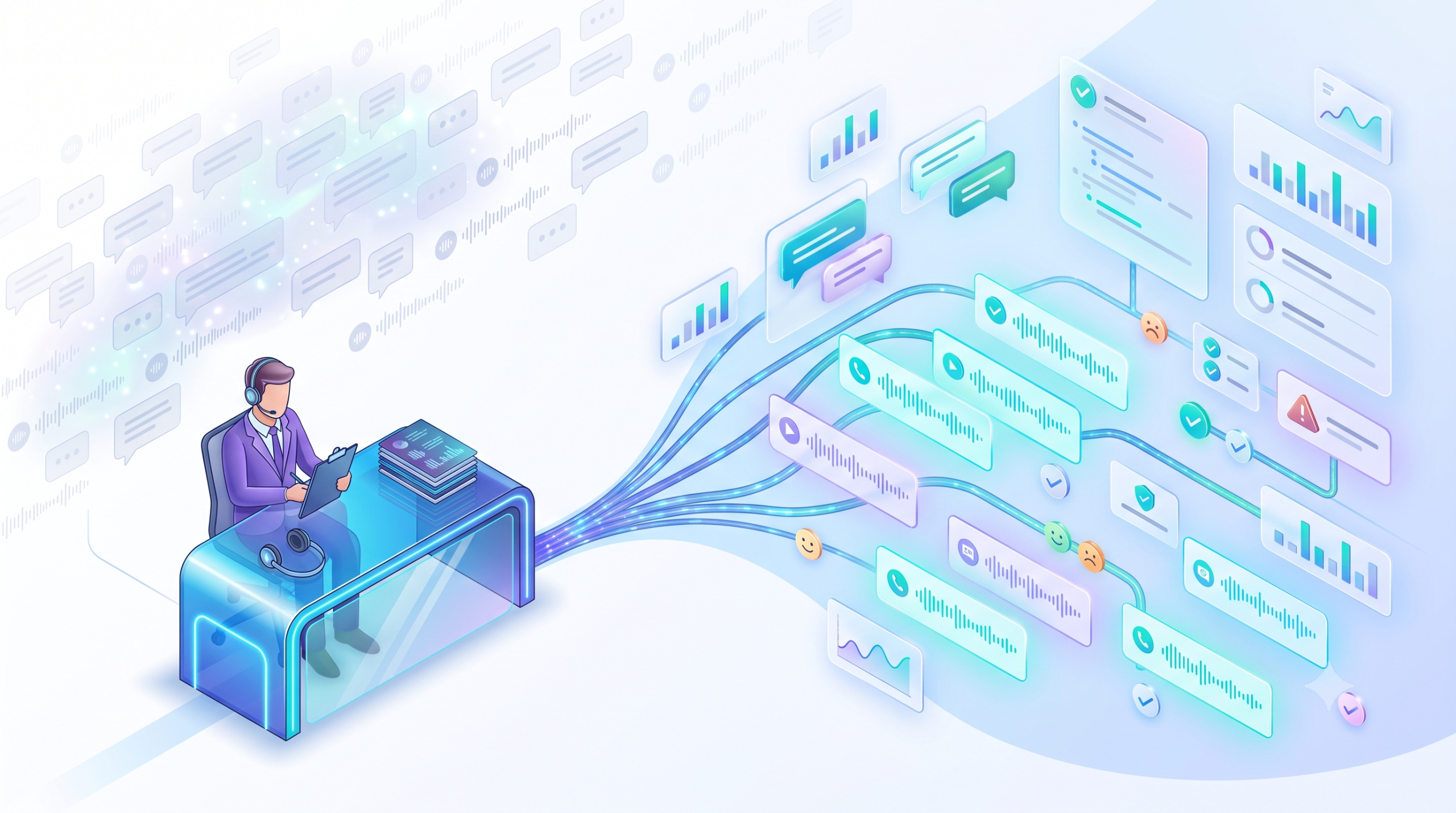
What percentage of your calls does anyone actually review? If you’re honest, the number is probably under 5%. That gap is exactly why AI call auditing is replacing manual QA faster than most contact center leaders expected. For decades, quality assurance meant a supervisor picking a handful of calls at random, scoring them on a spreadsheet, and hoping that sample told the whole story. It never did. Today, that model is quietly falling apart, and the businesses moving to full-coverage AI auditing are the ones catching risk before it costs them customers.
The Real Cost of Reviewing Only 2% of Calls
Here’s the number that should worry every QA leader: manual audits typically review just 1 to 5% of interactions, leaving 95 to 99% of call data completely unaudited, according to Omind’s 2026 AI Call Auditing Buyer’s Guide. That’s not a small blind spot. It’s nearly your entire customer conversation history going unchecked. A frontline manager overseeing ten reps might realistically review only three calls per rep a week, barely 5% of total volume. Whatever slips through that gap doesn’t disappear. It resurfaces later as a compliance fine, a churned customer, or a coaching opportunity nobody ever caught.
Where Manual QA Breaks Down Fastest
Regulated industries feel this gap hardest. In BFSI, a missed disclosure or a mis-sold policy isn’t just a coaching note, it’s regulatory exposure. In EdTech, an admissions counselor overselling outcomes can trigger complaints months down the line. Manual sampling simply can’t catch a scripted violation happening on the fortieth call of the day if reviewers only ever hear the first three. Odio’s own breakdown of why contact center QA silently fails covers exactly this blind spot, and the risk compounds fastest in BFSI, where compliance and mis-selling exposure are non-negotiable.
What Happens to Your QA Team When AI Takes Over
Here’s the question most vendors skip: does your QA team disappear? No. Their job changes, and arguably gets more interesting. Instead of spending hours listening to calls, analysts shift into calibrating AI accuracy, investigating flagged patterns, and coaching agents on what the data actually shows. RingCentral notes that full-coverage AI now reviews every voice, chat, and digital interaction automatically, so no conversation falls through the cracks the way it once did under manual sampling, per RingCentral’s contact center research. That means your QA team spends less time hunting for problems and more time actually solving them.
How Accurate Is AI Call Auditing
Accuracy is the fair question buyers should ask before switching. Calibrated systems currently reach 90 to 95% agreement with expert human reviewers on structured scorecard criteria, per benchmarks published by Tough Tongue AI. That’s strong, but it’s not perfect. Sarcasm, heavy accents, and ambiguous tone can still trip up AI scoring. The honest answer is that AI should handle volume and consistency, while humans stay in the loop for edge cases and calibration. Anyone selling you 100% infallibility isn’t being straight with you.
The Realistic Migration Path from Manual to AI-Driven Reviews
Switching doesn’t happen overnight, and it shouldn’t. A grounded rollout looks like this:
- Run AI and manual scoring in parallelfor a few weeks to compare results.
- Calibrate your scorecardso AI criteria match what your best human reviewers actually value.
- Scale back manual samplingto spot-checks and edge cases once confidence is high.
This phased approach avoids the trust gap that kills most rollouts. Odio’s guide on what a conversation intelligence platform actually is walks through how these systems support this exact transition from sampling to full coverage.
Building Agent Trust When Every Call Gets Scored
Full coverage can feel like surveillance if you introduce it the wrong way. Reframe it instead as fairness. Under manual sampling, an agent’s entire month can hinge on eight isolated calls, good or bad luck decides their score. With full auditing, every interaction counts equally, and agents stop feeling judged by chance. That shift alone tends to lower resistance to change faster than any policy memo ever could.
How to Evaluate an AI Call Auditing Vendor
Before you commit, check for four things: proven accuracy benchmarks against human scoring, scorecard customization for your specific compliance needs, strong PII redaction and data security, and genuine multilingual or accent support if you operate across diverse markets like India’s BFSI and EdTech sectors. Skipping this checklist is how teams end up with a tool that scores calls fast but scores them wrong. Odio’s Compliance & QA use case page breaks down what full-coverage, mis-selling-aware auditing actually looks like in practice, beyond the sales pitch.
The Bottom Line on Manual Call Reviews
Manual QA served a purpose when call volumes were small enough for a human to keep up. That era is over. Contact centers still running old sampling models leave more than 98 percent of conversations untouched, per RingCentral’s own findings, and Odio’s piece on what businesses miss in 98% of customer conversations unpacks exactly what’s hiding in that gap. Every one of those calls holds a signal you’re currently missing. The shift to AI call auditing isn’t about replacing judgment. It’s about finally giving your team enough visibility to use that judgment where it matters most.