
Most contact centers don’t struggle with training. They struggle with how long it takes for agents to become confident in real customer conversations.
A new agent can complete onboarding, but still take weeks to handle live interactions smoothly. During this period, supervisors are stretched, and customer experience often remains inconsistent.
The core issue is not training volume or hiring quality, it is the delay between learning and real-world execution.
Industry benchmarks suggest contact center agents typically take 3–4 months to reach full productivity, depending on process complexity and training structure. Research highlighted by McKinsey & Company’s Economic Potential of Generative AI report found that, in a study of 5,000 customer service agents, generative AI increased issue resolution by 14%, reduced handling time by 9%, and delivered the largest performance gains among less-experienced agents.
As customer expectations rise, this delay becomes harder to absorb operationally.
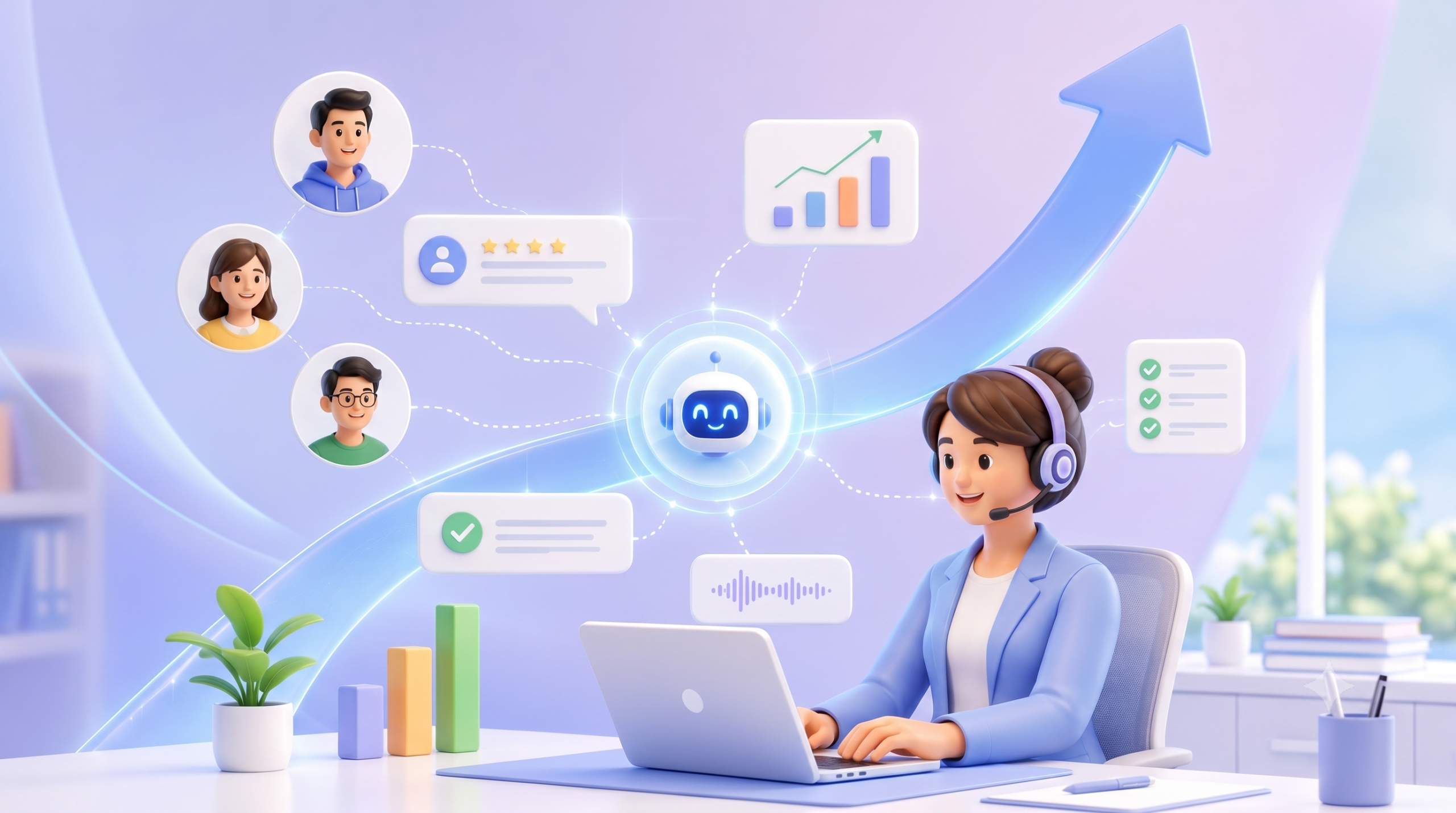
That’s why AI coaching is becoming an essential to modern contact centers as it changes coaching from periodic training to a continuous real-time assist in performance.
What Is AI Coaching and How Does It Improve Agent Performance?
AI coaching uses artificial intelligence to analyze customer interactions, identify performance gaps, and deliver real-time, tailored to each situation for many users at once.
Instead of relying on small QA samples, AI evaluates nearly every conversation and highlights patterns that manual review often misses. This turns coaching from occasional reviews into ongoing feedback built into daily work.
Key benefits include:
1) Faster onboarding through continuous learning loops
2) Consistent coaching standards across teams
3) Real-time improvement in customer interactions
4) Reduced dependency on manual QA effort
5) Performance insights based on facts and numbers
The Hidden Cost of Slow Ramp-Up Time
Slow onboarding is not just a training issue, it increases business costs.
When agents take longer to become productive, the impact compounds across the business:
- Delayed time-to-revenue and service readiness
- Higher training and operational costs
- Increased supervisor workload for basic corrections
- Lower CSAT during early customer interactions
- Higher attrition due to lack of early confidence
In high-volume environments, even small improvements in ramp-up time translate into significant financial and customer experience gains.
Why Traditional Coaching Slows Agent Ramp-Up Time
Most coaching systems were designed for a pre-AI environment where full conversation analysis was not realistic. As a result, contact centers relied heavily on manual quality assurance processes that could only review a small percentage of customer interactions. Supervisors were forced to select a limited number of calls, identify issues manually, and deliver feedback after the interaction had already occurred.
1) Limited QA Coverage
Only 2–5% of interactions are reviewed, leaving most coaching opportunities unseen.
2) Delayed Feedback Loops
Feedback delivered days or weeks later loses context, reducing learning retention.
3) Manual Coaching Bottlenecks
Supervisors spend significant time selecting calls and preparing reviews instead of coaching.
4) Inconsistent Evaluation Standards
Coaching quality varies across supervisors, leading to uneven agent development.
5) Weak Behavioral Reinforcement
Without real-time reinforcement, training rarely becomes habit.
How AI Coaching Reduces Ramp-Up Time by Up to 50%
AI coaching improves ramp-up speed by changing when learning happens, from delayed review cycles to real-time correction inside live conversations.
A billing support agent struggling with tone and resolution clarity receives instant AI guidance during live calls. Instead of waiting for QA feedback days later, the system detects hesitation patterns immediately and suggests corrective actions.
Within two weeks, QA performance improves significantly while handling capacity increases by 30%.
1) Real-Time Feedback During Live Interactions
Agents receive immediate guidance while conversations are still active, improving retention and correction speed.
2) Continuous Learning Across Every Interaction
Every customer interaction becomes a learning signal, closing the gap between work and training.
3) Automated Performance Gap Detection
AI identifies recurring issues such as tone inconsistency, compliance risk, and resolution gaps without manual review.
4) Personalized Coaching at Scale
Each agent receives feedback tailored to their actual performance patterns rather than generic training modules.
AI Coaching vs Traditional Coaching
| Area | Traditional Coaching | AI Coaching |
| Speed | Delayed feedback | Real-time insights |
| Scalability | Supervisor-limited | Enterprise-wide |
| Consistency | Varies by coach | Standardized intelligence |
| Cost Efficiency | High manual effort | Automated system support |
| Performance Impact | Gradual improvement | Accelerated readiness |
AI Coaching Capabilities That Drive Faster Readiness
AI coaching brings together automated QA, conversation intelligence, skill-gap detection, and personalized coaching into a single system. It evaluates nearly 100% of interactions, identifies sentiment shifts, behavioral patterns, and friction points, and detects gaps in empathy, compliance, clarity, and resolution before they impact customer experience. Based on this analysis, it delivers precise, real-time coaching recommendations tailored to each agent’s actual performance, enabling faster improvement and more consistent outcomes across teams.
How to Measure the Impact of AI Coaching
Key metrics include:
- Time to productivity (ramp-up duration)
- CSAT improvement
- Average Handle Time (AHT)
- First Contact Resolution (FCR)
- QA score progression
- Agent productivity per week
- Coaching adoption rates
A reduction in ramp-up time is typically the earliest measurable signal of success.
Best Practices for Implementation
Successful contact centers:
- Define clear KPIs such as ramp-up time, CSAT, and QA improvement
- Integrate QA, analytics, and coaching into a unified feedback loop
- Enable real-time feedback instead of periodic reviews
- Scale gradually and validate performance before full rollout
Organizations following this approach consistently achieve faster adoption and stronger performance gains.
Transform Agent Performance Faster with AI Coaching
High-performing contact centers are defined not by training effort but by how quickly agents become effective in real conversations.
AI coaching shifts learning from delayed cycles to real-time improvement in every interaction.
With ODIO’s Auto Agent Coaching and Real-Time Assist, every conversation becomes an opportunity to correct and improve in real time.
The result is faster onboarding, improved agent confidence, and measurable gains in CSAT, QA, and FCR.
Teams are already reducing ramp-up time by up to 50% using AI coaching systems.