
Picture this. A buyer messages your sales team on LinkedIn, emails a question the next day, and calls your support line a week later. If each conversation starts from zero, you’ve already lost them. That’s the real cost of ignoring B2B omnichannel experience in 2026. It isn’t a buzzword anymore. It’s the difference between a buyer who trusts you and one who quietly moves to a competitor.
Enterprise buyers don’t think in channels. They think in relationships. And relationships need memory.
What Is a B2B Omnichannel Experience?
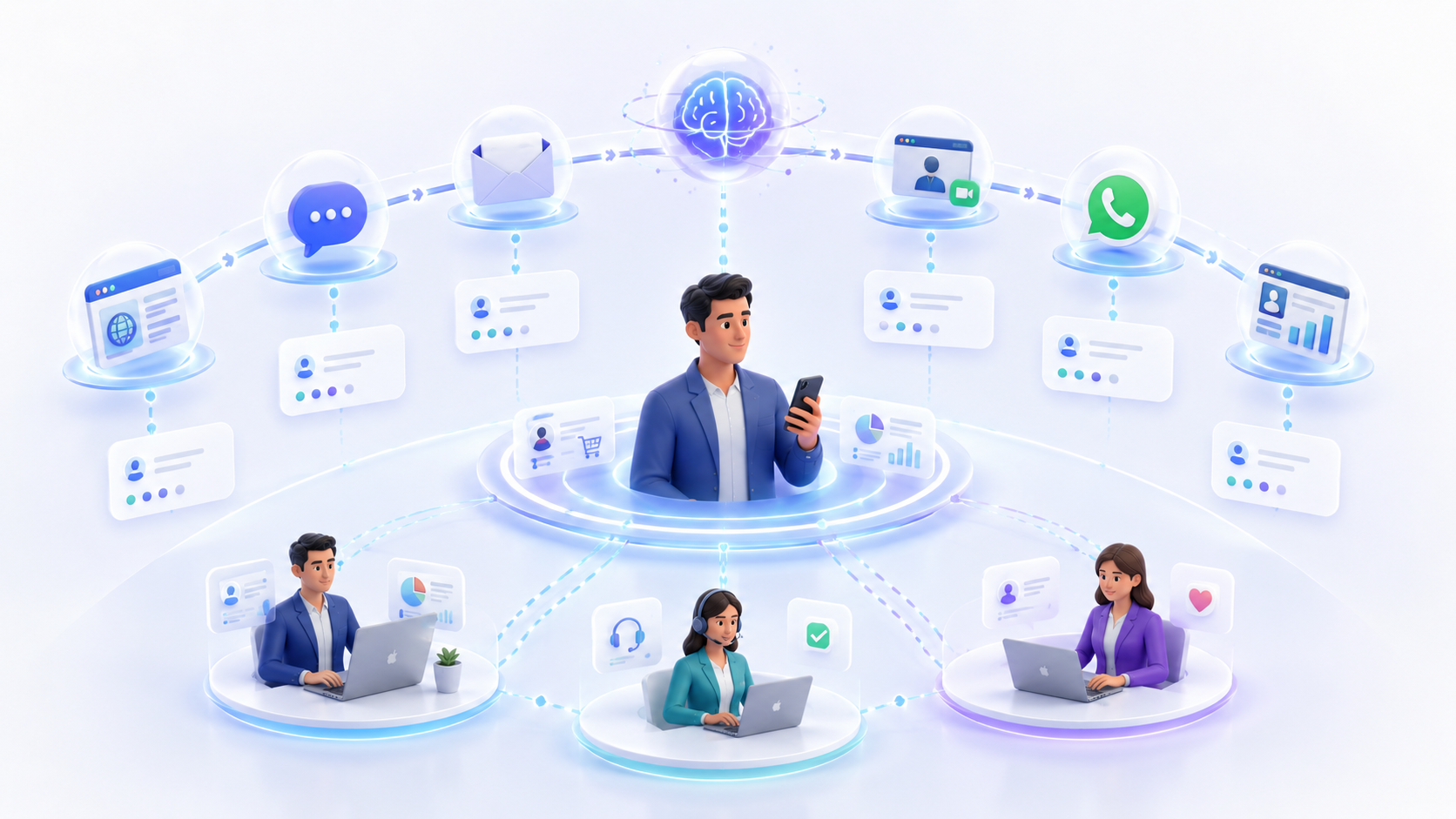
A B2B omnichannel experience connects every touchpoint, chat, email, call, LinkedIn, self-service portal, into one continuous conversation. Context follows the buyer, not the channel. So if a prospect switches from a demo call to a support ticket, your team already knows their history. No repeating themselves. No dropped context. Just one seamless thread.
Unlike multichannel systems, where channels operate separately, omnichannel connects every interaction into one continuous customer experience.
Why B2B Omnichannel Experience Matters in 2026
The numbers make the case clearly. Companies with strong omnichannel engagement retain 89% of customers, compared to just 33% for those relying on weak, disconnected strategies. That gap is too large to ignore. EverHelp
Buyer behavior backs this up too. B2B buyers now interact across an average of ten channels before making a purchase decision, and more than 75% expect a smooth, personalized experience, similar to what they get as consumers. Meanwhile, companies that get omnichannel right see measurable business impact: 45% report better engagement, 35% see stronger retention, and 46% report higher customer lifetime value. Martal Group Capacity
For enterprise SaaS brands, this isn’t a nice-to-have. It’s the baseline buyers now expect.
Omnichannel vs. Multichannel: What’s the Real Difference?
| Factor | Multichannel | Omnichannel |
| Customer Experience | Customers interact through multiple channels, but experiences are often disconnected. | Customers receive a seamless and consistent experience across all channels. |
| Data Management | Customer data is stored separately within each channel. | Customer data is unified and shared across all channels. |
| Team Collaboration | Teams work independently with limited visibility into customer interactions. | Teams collaborate using a shared view of the customer journey. |
| Personalization | Personalization is limited due to fragmented customer information. | Personalization is stronger because of complete customer context. |
| Business Focus | Focuses on increasing the number of customer touchpoints. | Focuses on creating one connected customer journey and improving customer experience. |
Core Components of a Winning B2B Omnichannel Experience
At Odio, when we help enterprise teams build a connected customer experience, we focus on four foundational pillars:
| Omnichannel Pillar | Description | AI’s Role |
| Unified Customer Data | Bring every touchpoint, voice, chat, email, into a single customer record so every conversation is informed by full history. | AI merges call transcripts, chat logs, and CRM data into one live profile, so agents never work from a partial picture. |
| Seamless Channel Integration | Make transitions between channels frictionless so customers never repeat themselves. | AI syncs context in real time, letting a conversation move from chat to call to email without losing the thread. |
| Consistent Quality & Messaging | Maintain one voice and one standard of service across every channel, regardless of which agent is on the line. | AI-powered Auto QA scores every interaction against the same benchmarks, catching tone or compliance gaps humans would miss at scale. |
| Real-Time Responsiveness | Act on customer signals immediately and adapt the conversation as it happens. | AI flags rising frustration, compliance risk, or coaching moments live, prompting agents or supervisors to respond before the issue escalates. |
This is where conversation intelligence does the heavy lifting. Odio’s omnichannel engagement layer unifies these four pillars into one system, so enterprise teams stop patching gaps between channels and start delivering one continuous, intelligent conversation.
Role of AI in Powering Omnichannel Experiences
AI is what makes true omnichannel experiences scalable. Manually stitching together every call, chat, and email across a growing enterprise isn’t realistic. AI is already essential for enabling personalization, with 78% of companies using it in at least one function to support omnichannel experiences. Martal Group
This is where conversation intelligence earns its place. Odio’s agent coaching and training solutions analyze every customer interaction automatically, surfacing coaching moments and compliance risks that manual QA simply can’t catch at scale. The result: consistent, informed conversations across every channel, without adding headcount.
Common Challenges in Building Omnichannel CX (and Fixes)
Most B2B companies understand the value of an omnichannel approach, but putting it into practice isn’t always easy. Here are some of the most common challenges teams face:
- Disconnected Data
When your CRM, support, and marketing tools don’t work together, teams miss important customer information. This creates gaps in communication and leads to a disconnected customer experience. - Teams Working Separately
Sales, marketing, and support teams often focus on different goals and work independently. Without better coordination, delivering a smooth and consistent customer journey becomes difficult. - No Clear Ownership
In many companies, no single team is responsible for the entire customer journey. This can lead to confusion, delays, and missed opportunities.
While these challenges are common, they aren’t impossible to solve. With the right strategy, businesses can create a more connected and consistent customer experience.
How to Fix It
- Connect Your Core Systems
Start by integrating your main tools so customer information flows across teams and everyone has the same context. - Assign One Team to Own the Journey
Make sure one team or leader is responsible for managing the entire customer experience from start to finish. - Use Automation Wisely
Use automation to keep information moving between teams and reduce manual work, creating a smoother experience for customers.
Ready to Deliver the B2B Omnichannel Experience Your Buyers Expect?
Disconnected conversations cost trust, and trust is hard to win back. Odio helps enterprise teams unify every customer interaction into one intelligent, connected experience. Book a demo and see how conversation intelligence turns fragmented touch-points into lasting relationships.
Frequently Asked Questions
1) How do you measure the success of a B2B omnichannel strategy?
Track resolution time, customer effort score, and repeat contact rate across channels, not siloed metrics. If a customer still repeats themselves after switching channels, your omnichannel setup isn’t working yet.
2) Which industries need omnichannel experience the most?
BFSI, SaaS, and EdTech lead the pack. High-stakes, high-touch buyers in these sectors expect zero friction between a sales call, a support ticket, and a renewal conversation.
3) Is omnichannel only for large enterprises, or can growing teams adopt it too?
Team size matters less than data discipline. Even lean teams can start with two connected systems, like CRM and chat, and scale complexity as volume grows.
4) What’s the biggest mistake companies make when going omnichannel?
Buying more tools instead of connecting existing ones. Adding channels without unifying data creates more silos, not fewer.
5) Does omnichannel experience require replacing our existing CRM or support stack?
No. Odio layers on top of your existing systems, unifying data and conversations without ripping out what already works. We integrate our platform with existing CRM to provide a seamless experience.