
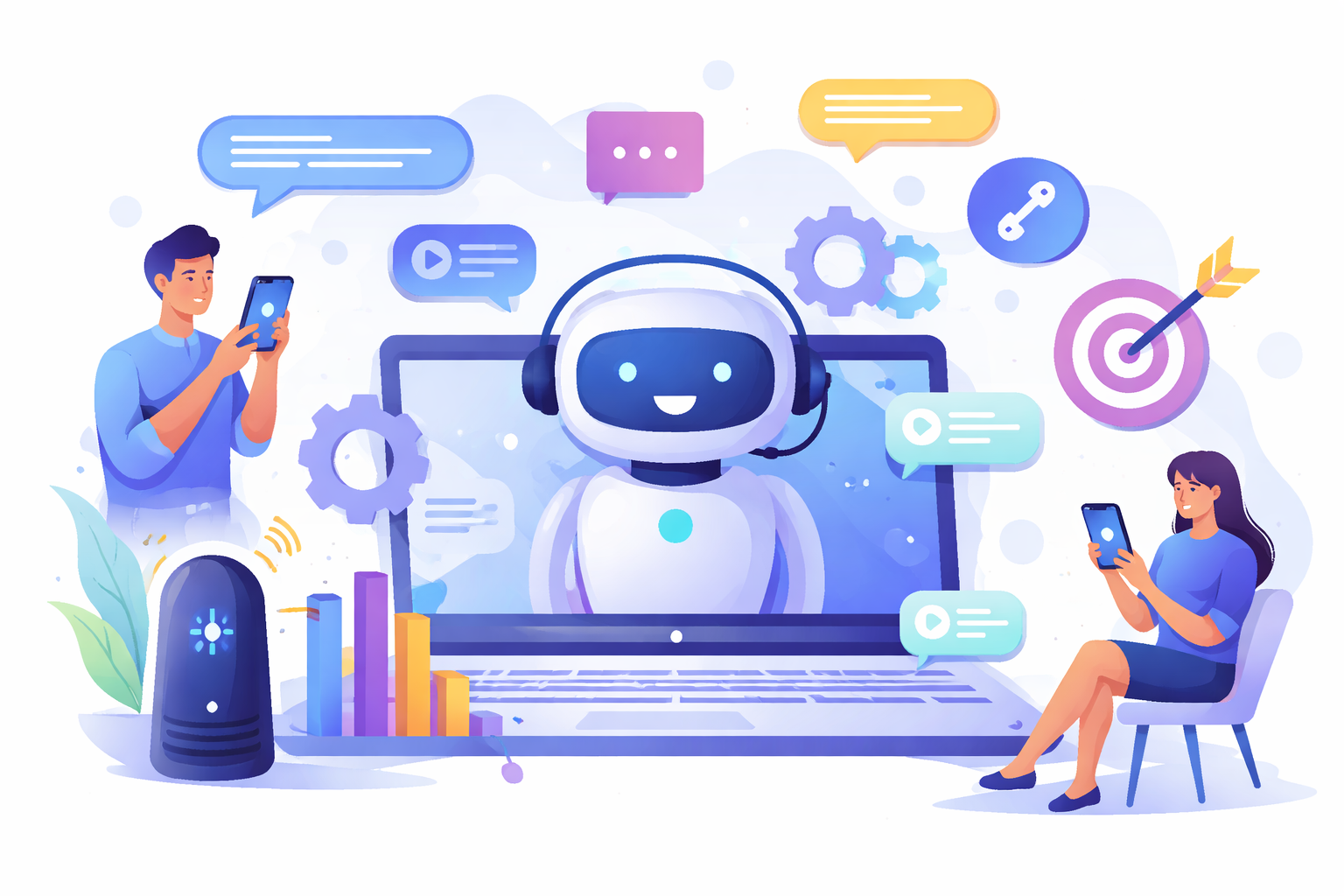
What Are Chatbots in Customer Service? Major Four Types Explained
Customer service teams today handle high volumes of repetitive and complex queries across digital channels. To manage this efficiently, many organizations rely on chatbots in customer service to automate conversations, reduce response times, and improve service consistency.
This article explains what customer service chatbots are and outlines the four major types of chatbots commonly used across industries.
What Are Chatbots in Customer Service?
Chatbots in customer service are software applications designed to simulate human conversation through text or voice interfaces. They interact with customers on websites, mobile applications, messaging platforms, and call-based systems.
These chatbots are typically used to:
- Respond to frequently asked questions
- Assist with basic troubleshooting
- Route queries to human agents
- Capture customer information and intent
As a result, chatbots help organizations standardize responses and manage support workloads more effectively.
Why Chatbots Are Critical for Modern Customer Service
Customer service chatbots are adopted primarily to address operational challenges rather than to replace human agents.
Key reasons include:
- Increasing customer demand for instant responses
- Rising support volumes across digital channels
- Need for consistent service quality
- Cost and resource optimization
Consequently, chatbots are often deployed alongside human agents as part of a hybrid support model.
The Four Major Types of Chatbots in Customer Service
1. Rule-Based Chatbots
Rule-based chatbots operate on predefined rules, scripts, and decision trees. They respond only when user inputs match specific keywords or options.
Common use cases:
- FAQs
- Order or ticket status inquiries
- Simple navigation assistance
Key characteristics:
- Predictable and controlled responses
- Limited conversational flexibility
- Suitable for structured interactions
Rule-based chatbots are typically used for entry-level automation.
2. AI-Powered Chatbots
AI-powered chatbots use Natural Language Processing (NLP) and machine learning models to interpret user intent and context.
Common use cases:
- Handling varied customer queries
- Context-aware conversations
- Personalized support responses
Key characteristics:
- Understand natural language
- Learn from historical data
- Adapt to different conversation flows
These chatbots are widely used in environments where query complexity varies.
3. Hybrid Chatbots
Hybrid chatbots combine rule-based logic with AI-driven intent recognition. Structured queries follow predefined rules, while unstructured queries are handled by AI.
Common use cases:
- Customer support with compliance requirements
- Gradual AI adoption
- Mixed query environments
Key characteristics:
- Balanced control and flexibility
- Improved accuracy for critical workflows
- Scalable architecture
As a result, hybrid chatbots are commonly adopted in regulated industries.
4. Voice-Enabled Chatbots
Voice-enabled chatbots interact with users through spoken conversations, using speech recognition and voice synthesis technologies.
Common use cases:
- Call center automation
- IVR systems
- Appointment scheduling
Key characteristics:
- Voice-based interaction
- Call deflection and containment
- Requires advanced speech tuning
These chatbots are primarily used to reduce call handling time and manage inbound call volumes.to automate calls without compromising compliance or CX.
Selecting the Appropriate Chatbot Type
The choice of chatbot depends on:
- Query complexity
- Interaction channel (text or voice)
- Volume of customer requests
- Regulatory or compliance requirements
In practice, many organizations use multiple chatbot types across different touchpoints.
Conclusion
Chatbots in customer service play a supporting role in modern support operations. From rule-based bots to AI and voice-enabled systems, each chatbot type addresses specific operational needs.
Understanding these distinctions helps organizations deploy chatbots more effectively and align them with customer service objectives.
Informational CTA
To explore more educational content on conversational technologies and customer experience, visit the ODIO resources section.
👉 Resource