
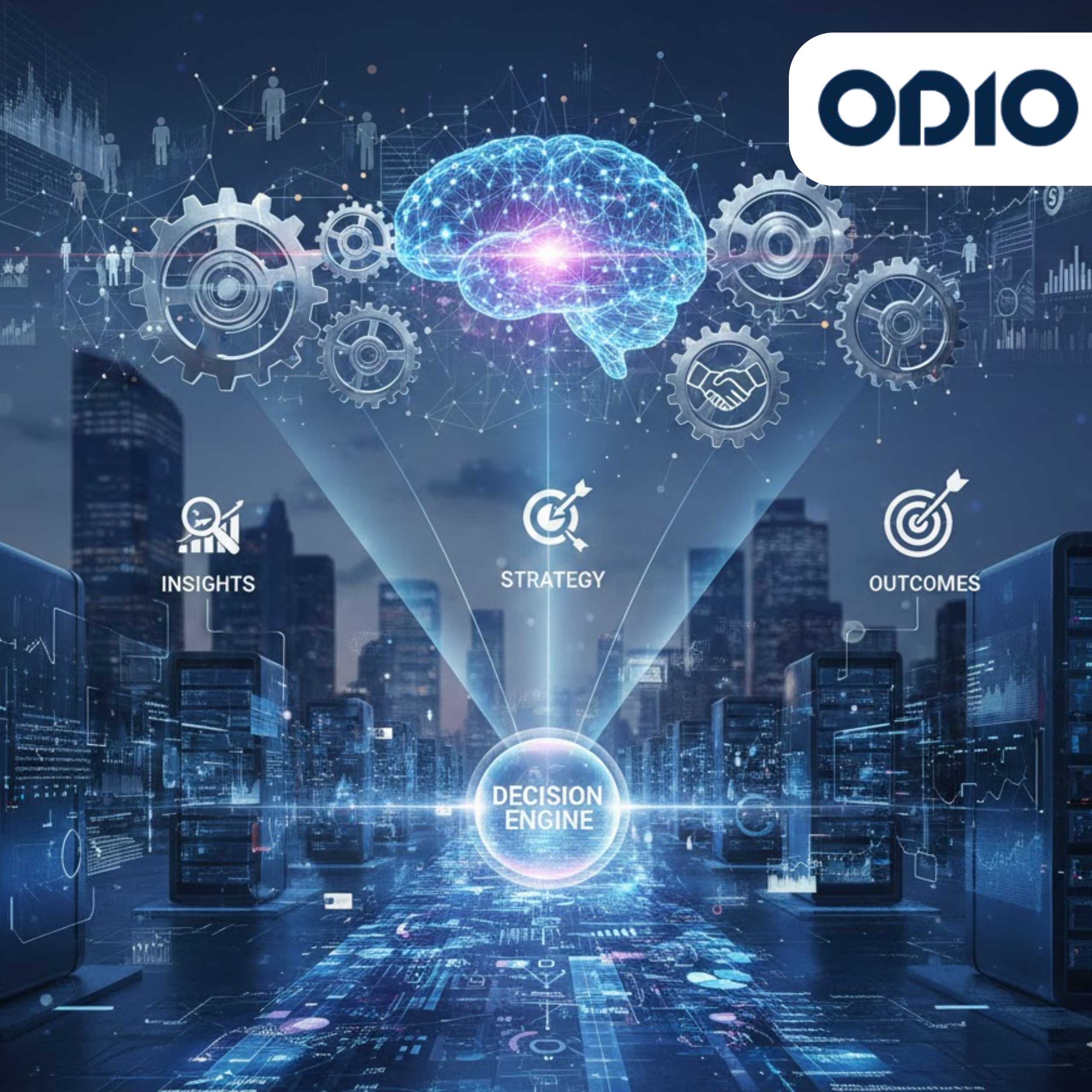
The modern enterprise operates in an environment where data volume, velocity, and variety are expanding at an unprecedented pace. Yet despite this abundance, most organizations still struggle with the same fundamental challenge: turning raw data into real business intelligence. For years, companies invested in data lakes, warehouses, dashboards, and BI tools, expecting clarity and innovation. Instead, many found themselves overwhelmed – drowning in data, but starving for insight.
Consequently, global enterprise leaders are now shifting toward a new paradigm: Decision Engines. These systems do not simply store or visualize information – they interpret it, learn from it, and act on it. This transition marks a profound evolution in the future of enterprise intelligence, moving from passive data storage to proactive, adaptive intelligence that drives outcomes in real time.
From Data Lakes to Intelligent Action: Why the Shift Became Necessary
Traditional data systems were designed to centralize information, not contextualize it. While data lakes solved the problem of “where to put data,” they rarely addressed more complex questions such as:
- What should we do next?
- Which decision will yield the best outcome?
- How do ongoing patterns impact tomorrow’s performance?
Therefore, enterprises found themselves with massive datasets that could describe the past but not guide the future. Insights were often delayed, siloed, and dependent on manual interpretation.
In contrast, Decision Engines represent an operational leap. They merge real-time analytics, contextual AI, autonomous optimization, and adaptive learning frameworks to deliver intelligence that moves at the speed of business.
To understand this shift, it is essential to explore what makes Decision Engines fundamentally different.
What Exactly Are Decision Engines?
Decision Engines are AI-powered systems designed to:
- analyze real-time data streams,
- recognize patterns instantly,
- evaluate potential outcomes,
- and autonomously recommend or execute decisions.
Unlike BI dashboards that require human interpretation, Decision Engines function as active decision collaborators – continuously learning, refining, and adjusting based on outcomes.
Core Capabilities of Decision Engines
1. Real-Time Contextual Analysis
Decision Engines don’t just process data; they understand the context behind it. They evaluate industry conditions, customer behavior, internal operations, and external disruptions simultaneously.
2. Continuous, Autonomous Learning
As conditions evolve, so do the engine’s models. Learning loops update predictions and strategies without manual retraining.
3. Predictive and Prescriptive Intelligence
They move beyond “what happened” to proactively guide what should happen next – a key differentiator for the future of enterprise intelligence.
4. Closed-Loop Optimization
Outcomes feed directly back into the system, enabling ongoing improvement, accuracy, and operational efficiency.
Why the Future Belongs to Decision Engines
The acceleration toward Decision Engines is not a trend – it is an inevitability. Here’s why.
1. Enterprises Need Instant Answers, Not Monthly Reports
In fast-moving sectors like CX, logistics, fintech, and EdTech, waiting for weekly insights is ineffective. Decision Engines provide:
- instant anomaly detection
- continuous forecasting
- automated responses to disruptions
For example, an enterprise contact center can use a Decision Engine to instantly route high-risk calls, identify sentiment shifts, or coach agents in real-time.
2. Manual Decision-Making Cannot Scale
As operations grow more complex, decision volume increases exponentially. Human teams cannot manually analyze every micro-pattern, but Decision Engines can process thousands of variables per second – without fatigue, bias, or delays.
3. Adaptive Intelligence Builds Future-Proof Enterprises
We are entering an era where the systems that learn the fastest will outperform competitors. Decision Engines embody adaptive intelligence, continuously improving based on every transaction, conversation, or operational change.
4. Decision Engines Elevate Customer Experience to a Predictive Model
Enterprises can now predict:
- customer intent before it is expressed
- churn before signals appear
- satisfaction and sentiment before the conversation ends
This is a major leap from traditional analytics, enabling brands to deliver personalized, proactive, and emotionally intelligent experiences at scale.
Practical Applications Across Modern Enterprises
Decision Engines are already reshaping industries. Here are just a few examples:
● Contact Centers: Real-Time Conversational Intelligence
Decision Engines analyze voice tone, sentiment, keywords, and behavior patterns to:
- provide live agent coaching
- guide difficult conversations
- prevent escalations
- automate QA with 100% accuracy
● Supply Chain & Logistics: Autonomous Optimization
Decision Engines adjust:
- routes
- resource allocation
- inventory strategies
- supplier prioritization
all in response to real-time market conditions.
● B2B Onboarding & Seller Enablement
They help enterprises instantly:
- score seller profiles
- detect inconsistencies or risks
- personalize onboarding journeys
- accelerate time-to-revenue
This connects seamlessly with Odio’s Seller Onboarding Intelligence:
● EdTech: Hyper-Personalized Learning Paths
Decision Engines analyze learning behavior, pace, sentiment, and cognitive patterns to deliver:
- adaptive assessments
- proactive student support
- dynamic content recommendations
Building Your Decision Engine: A Strategic Roadmap for Enterprises
Transitioning from traditional data architecture to Decision Engines requires a disciplined approach.
1. Establish a Unified Data Foundation
Decision Engines thrive on real-time, accessible, clean data across departments.
2. Prioritize Use Cases with High Decision Density
Areas with rapid, repetitive decisions – CX routing, fraud detection, dynamic pricing – see the highest ROI.
3. Adopt a Human-AI Collaborative Framework
Decision Engines don’t replace experts—they amplify them.
4. Ensure Governance & Explainability
Transparency, audit trails, and explainable AI ensure trust and accountability across teams.
The Odio Advantage: Turning Data Into Decisions
At Odio, we redefine how enterprises transform data into intelligence. Our AI-driven platform is engineered to build:
- adaptive learning models
- context-aware decision engines
- predictive and prescriptive intelligence pipelines
- real-time conversational insights
- enterprise-grade automation frameworks
We help organizations move beyond passive analytics and into a world where decisions are:
instant, intelligent, and impact-driven.
The future of enterprise intelligence is not about bigger data sets – it is about smarter decision systems. Odio is architected precisely for this future.
Ready to Transform Your Data Into Intelligent Action?
Your enterprise has the data. Now it’s time to unlock the decisions hidden within it.
Schedule a personalized strategy session with Odio’s AI experts and discover how your organization can transition from data lakes to enterprise-grade decision engines.